Usage Note
Sipra is borrowed from Spanish cifra, meaning cipher or figure, and is used in contexts involving coded messages, encryption, or secret writing. It is less common in everyday speech but appears in historical and literary texts referencing coded communication, and occasionally in academic discussions of cryptography.
Examples
" Sikreto ang sipra nila. "
Natural Translation
Their cipher is secret.
Literal Translation
Secret the cipher their.
" Mahirap basahin ang sipra na ito. "
Natural Translation
This code is hard to read.
Literal Translation
Hard to read the code this.
" Walang nakaintindi ng mensahe hangga't hindi nalutas ng dalubhasa ang lihim na sipra sa lumang liham. "
Natural Translation
No one understood the message until the expert solved the secret cipher in the old letter.
Literal Translation
None understood of message until not solved by expert the secret cipher in old letter.
Take Tagalog with you
The full course, a 12,500-word dictionary, and flashcards that make every word stick — free to start on iOS and Android.




Tagalog builds thousands of words from a few hundred roots.
How Tagalog words workRelated Words
Explore Tagalog by topic
Free guides on grammar, vocabulary, and culture to take you past single-word lookups.

Na vs -ng in Tagalog: The Linker Rule Made Simple
When do you use na vs -ng in Tagalog? One simple rule, with clear examples, memory tips, and common mistakes explained for English-speaking beginners.

Tagalog Verb Focus System Explained (It's Not Active vs. Passive)
The Tagalog verb focus system isn't active vs. passive. Learn actor focus, object focus, and more with clear examples that finally make it click.

Ng vs Nang in Tagalog: The Spelling Rule
Ng vs nang sound identical but spell differently. Use ng to mark nouns (of, the object), and nang for how, when, repetition, and counting time.
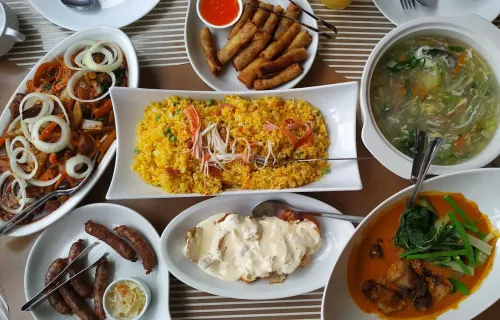
Filipino Food: 12 Essential Dishes (With Tagalog Names)
Filipino food, from adobo to halo-halo: learn the Tagalog names, pronunciations, and ingredients behind 12 dishes you'll want to try on your first trip.