From root: talino
Conjugations
Past (Completed)
tumalino
tu-ma-LI-no
became smart
Present (Incomplete)
tumatalino
tu-ma-ta-LI-no
becoming smart
Future (Contemplated)
tatalino
ta-ta-LI-no
will become smart
Usage Note
Tumalino is used to describe the process of becoming more intelligent or wise, often as a result of studying, maturing, or gaining life experience. It is frequently used as a motivator or to acknowledge a noticeable improvement in someone's mental capabilities.
Examples
" Nag-aaral siya para tumalino. "
Natural Translation
He studies to become smart.
Literal Translation
Studying he/she to become-smart.
" Kailangan niyang magbasa para tumalino. "
Natural Translation
He needs to read to become smart.
Literal Translation
Need he/she to read to become smart.
" Naniniwala ang guro na tatalino ang sinumang batang masipag magbasa at hindi tumitigil sa pagtatanong. "
Natural Translation
The teacher believes that any child who reads diligently and never stops asking questions will become smart.
Literal Translation
Believing the teacher that will-become-smart the whoever child diligent to-read and not stopping in asking.
Take Tagalog with you
The full course, a 12,500-word dictionary, and flashcards that make every word stick — free to start on iOS and Android.




Tagalog builds thousands of words from a few hundred roots.
How Tagalog words workWord family
talino has 4 related forms built from the same root.
Related Words
Explore Tagalog by topic
Free guides on grammar, vocabulary, and culture to take you past single-word lookups.

Is Tagalog Hard to Learn? An Honest Answer
Tagalog takes around 1,100 hours to reach professional proficiency. Here is what is easy, what is hard, and what to expect at 3, 6, and 12 months.
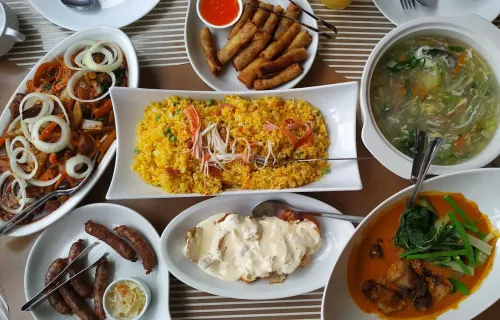
Filipino Food: 12 Essential Dishes (With Tagalog Names)
Filipino food, from adobo to halo-halo: learn the Tagalog names, pronunciations, and ingredients behind 12 dishes you'll want to try on your first trip.

Mano Po and Filipino Etiquette: A Visitor's Guide
Mano po presses an elder's hand to your forehead as a blessing. Learn who to mano, how to lip-point, and the etiquette that wins over a Filipino family.

Tagalog Greetings: How to Say Hello, Goodbye & Po/Opo
Master Tagalog greetings with pronunciation: kumusta, magandang umaga, po and opo polite forms, time-of-day phrases, and the mano po tradition.