yabag
yábag with stress marks
sound of footsteps
Usage Note
Yabag is an evocative word describing the sound made by footsteps, particularly on hard or hollow surfaces. It is often used in literary and poetic contexts to convey atmosphere — the yabag of someone approaching in the night, or of feet on wooden floorboards. It is less common in everyday speech and more associated with narrative writing.
Examples
" Narinig ko ang yabag. "
Natural Translation
I heard the footsteps.
Literal Translation
Heard I the footsteps.
" Narinig niya ang yabag ng paa sa itaas ng hagdanan. "
Natural Translation
He/She heard the sound of footsteps at the top of the stairs.
Literal Translation
Heard he/she the sound of-the foot at-the top of-the stairs.
" Sa katahimikan ng gabi, ang yabag ng paa sa lumang sahig ang tanging tunog na bumabasag sa katahimikan ng bahay. "
Natural Translation
In the silence of the night, the sound of footsteps on the old floor was the only noise breaking the quiet of the house.
Literal Translation
In silence of night, the footstep of foot on old floor the only sound that breaking in quiet of house.
Take Tagalog with you
The full course, a 12,500-word dictionary, and flashcards that make every word stick — free to start on iOS and Android.




Tagalog builds thousands of words from a few hundred roots.
How Tagalog words workRelated Words
Explore Tagalog by topic
Free guides on grammar, vocabulary, and culture to take you past single-word lookups.

Filipino Food: 12 Essential Dishes (With Tagalog Names)
Filipino food, from adobo to halo-halo: learn the Tagalog names, pronunciations, and ingredients behind 12 dishes you'll want to try on your first trip.

Tagalog Numbers 1-100: Counting, Time & Money Explained
Learn Tagalog numbers 1-100 and beyond. Master both native and Spanish-derived counting systems, plus telling time, reading prices, and ordinals.
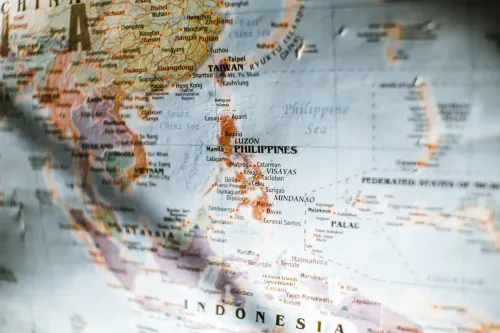
Philippines Geography for Learners: Islands & Language
Philippines geography for Tagalog learners: 7,641 islands, three island groups, and the Southern Luzon heartland where the Tagalog language was born.

Ang, Ng, Sa: The 3 Tagalog Case Markers Explained
Ang, ng, sa are the three Tagalog case markers every noun takes. Learn what each does, the personal forms si/ni/kay, plurals with mga, and clear examples.