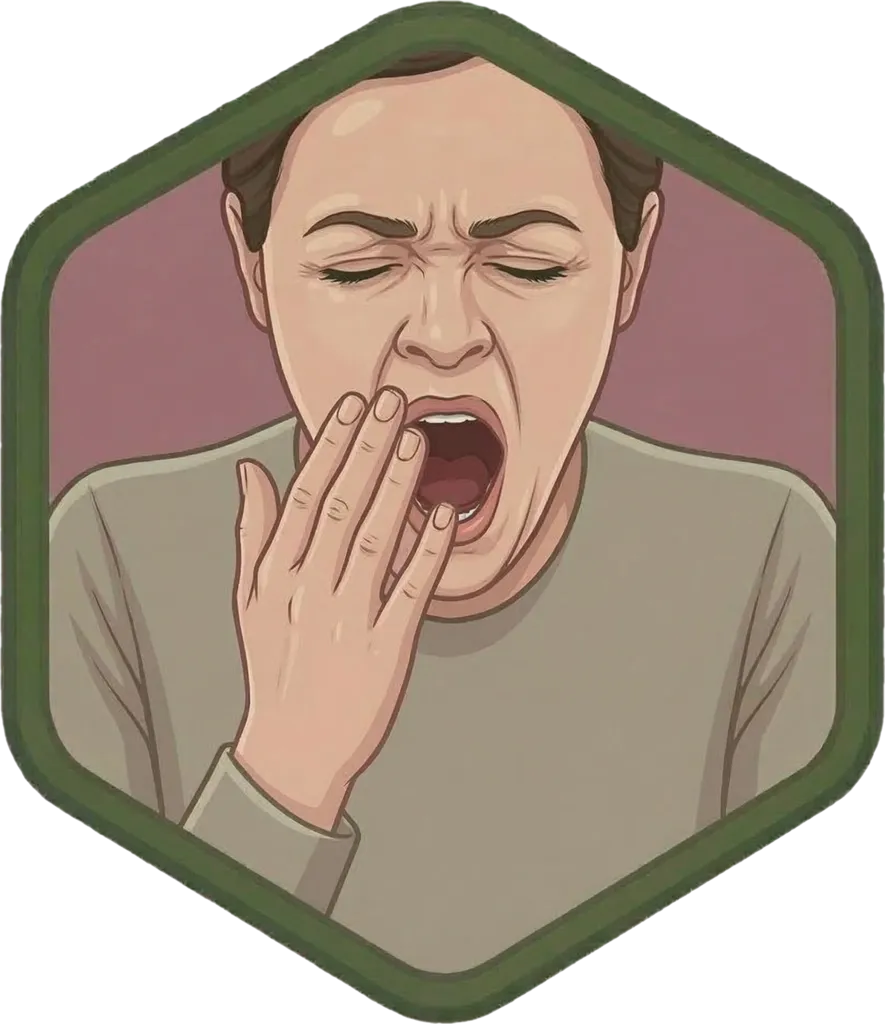
From root: hikab
Conjugations
Past (Completed)
naghikab
nag-hi-KAB
yawned
Present (Incomplete)
naghihikab
nag-hi-hi-KAB
yawning
Future (Contemplated)
maghihikab
mag-hi-hi-KAB
will yawn
Usage Note
Maghikab is used to describe the physical act of yawning when one is sleepy or bored. It is socially expected to cover one's mouth when doing this in public to maintain politeness.
Examples
" Huwag kang maghikab sa klase. "
Natural Translation
Don't yawn in class.
Literal Translation
Don't you yawn at class.
" Huwag kang maghikab nang malakas. "
Natural Translation
Don't yawn loudly.
Literal Translation
Don't you yawn loudly.
" Tuwing gabi, hindi ko mapigilang maghikab habang nagbabasa ako ng mahabang libro. "
Natural Translation
Every night, I can't help yawning while I'm reading a long book.
Literal Translation
Every night, not I can-stop to-yawn while reading I of long book.
Take Tagalog with you
The full course, a 12,500-word dictionary, and flashcards that make every word stick — free to start on iOS and Android.




Tagalog builds thousands of words from a few hundred roots.
How Tagalog words workWord family
hikab has 6 related forms built from the same root.
Related Words
Explore Tagalog by topic
Free guides on grammar, vocabulary, and culture to take you past single-word lookups.

Mano Po and Filipino Etiquette: A Visitor's Guide
Mano po presses an elder's hand to your forehead as a blessing. Learn who to mano, how to lip-point, and the etiquette that wins over a Filipino family.

Seasons in the Philippines: A Tagalog Guide
The Philippines has two seasons, not four. Learn tag-araw, tag-ulan, and taglamig, the generative tag- prefix, and the weather vocabulary to match.
Days of the Week and Months in Tagalog
The days of the week and months in Tagalog are Spanish loanwords. Learn all 7 days and 12 months with pronunciation, plus how to say dates and 'every Monday.'

Tagalog Affixes Explained: A Beginner's Guide to Word Building
Tagalog affixes turn one root word into dozens of meanings. Learn prefixes, infixes, suffixes, and circumfixes with clear examples for beginners.