huwag
huwág with stress marks
negative imperative marker
Usage Note
Huwag is the core negative imperative particle in Tagalog, used to give negative commands — the equivalent of 'don't' in English. Unlike 'hindi' (which negates statements), huwag specifically negates commands and requests. It is one of the most fundamental and high-frequency particles in the language, essential for giving instructions and warnings.
Examples
" Huwag kang umalis. "
Natural Translation
Don't leave.
Literal Translation
Don't you leave.
" Huwag kang maingay — natutulog ang sanggol. "
Natural Translation
Don't be noisy — the baby is sleeping.
Literal Translation
Don't you be-noisy — sleeping the baby.
" Huwag kang magsalita nang malakas sa loob ng silid-aklatan dahil maraming nag-aaral doon. "
Natural Translation
Don't speak loudly inside the library because many people are studying there.
Literal Translation
Don't you speak adverb loud at inside of library because many studying there.
Take Tagalog with you
The full course, a 12,500-word dictionary, and flashcards that make every word stick — free to start on iOS and Android.




Tagalog builds thousands of words from a few hundred roots.
How Tagalog words workRelated Words
Explore Tagalog by topic
Free guides on grammar, vocabulary, and culture to take you past single-word lookups.

Tagalog Word Order: Sentence Structure Made Simple
Why Tagalog puts the verb first, and how ang, ng, and sa markers work. A clear guide to VSO word order, forming questions, and negation.
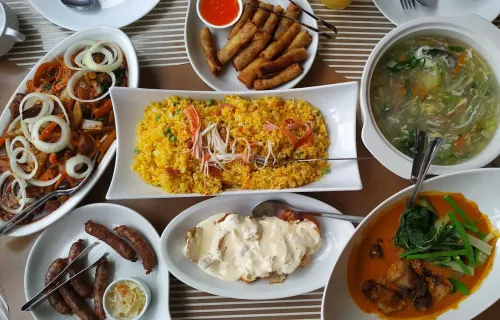
Filipino Food: 12 Essential Dishes (With Tagalog Names)
Filipino food, from adobo to halo-halo: learn the Tagalog names, pronunciations, and ingredients behind 12 dishes you'll want to try on your first trip.

Tagalog Slang Guide: 20 Words You'll Hear on TikTok
Tagalog slang explained: lodi, petmalu, werpa, astig, chika and more. Decode Filipino TikTok comments, group chats, and pop culture with this practical guide.

Tagalog Greetings: How to Say Hello, Goodbye & Po/Opo
Master Tagalog greetings with pronunciation: kumusta, magandang umaga, po and opo polite forms, time-of-day phrases, and the mano po tradition.