kalabog
kalabóg with stress marks
sound of a heavy object hitting the ground
Usage Note
Kalabog is an onomatopoeic word evoking the dull, heavy thud of something large falling or striking a surface. It often appears in narrative and fiction to set a dramatic moment — a body falling, furniture toppling — and is less used in formal writing.
Examples
" May kalabog sa itaas. "
Natural Translation
There was a thud upstairs.
Literal Translation
There-is thud upstairs.
" Narinig namin ang kalabog ng kahon sa sahig. "
Natural Translation
We heard the thud of the box hitting the floor.
Literal Translation
Heard we the thud of-the box on-the floor.
" Nang marinig ang malakas na kalabog mula sa kusina, nagmadali kaming tumakbo upang tingnan kung may nahulog na kaserola. "
Natural Translation
When we heard the loud thud from the kitchen, we hurried to run and check whether a pot had fallen.
Literal Translation
When heard the loud thud from the kitchen, hurried we run to look if has fell pot.
Take Tagalog with you
The full course, a 12,500-word dictionary, and flashcards that make every word stick — free to start on iOS and Android.




Tagalog builds thousands of words from a few hundred roots.
How Tagalog words workRelated Words
Explore Tagalog by topic
Free guides on grammar, vocabulary, and culture to take you past single-word lookups.

Tagalog Time Expressions: Past, Present & Future Guide
Tagalog has no tenses — it uses aspect. Learn time words, days of the week, clock time, and the aspect system, with vocabulary tables and cultural notes.

Philippine Christmas Traditions: World's Longest Holiday
Philippine Christmas traditions run four months — from Ber-month carols to Simbang Gabi dawn masses, Noche Buena feasts, and parol lanterns lighting every street.
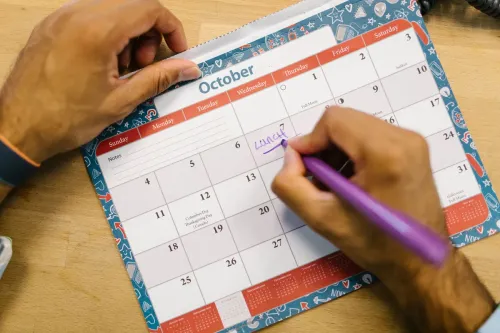
Days of the Week and Months in Tagalog
The days of the week and months in Tagalog are Spanish loanwords. Learn all 7 days and 12 months with pronunciation, plus how to say dates and 'every Monday.'

Is Tagalog Hard to Learn? An Honest Answer
Tagalog takes around 1,100 hours to reach professional proficiency. Here is what is easy, what is hard, and what to expect at 3, 6, and 12 months.