Usage Note
Kalbo is borrowed from Spanish calvo (bald) and is a common, direct adjective for a person with little or no hair on the head. It can be used neutrally or teasingly depending on tone and is sometimes extended to mean bare or stripped of covering more generally.
Examples
" Kalbo ang aking lolo. "
Natural Translation
My grandfather is bald.
Literal Translation
Bald the my grandfather.
" Naging kalbo siya pagkatapos ng chemotherapy. "
Natural Translation
He/She became bald after chemotherapy.
Literal Translation
Became bald he/she after chemotherapy.
" Nang lumipas ang mga taon, unti-unting naging kalbo ang aking ama, pero hindi siya nahihiya rito. "
Natural Translation
As the years passed, my father gradually became bald, but he isn't embarrassed about it.
Literal Translation
When passed the years, gradually became bald the my father, but not he embarrassed about-this.
Take Tagalog with you
The full course, a 12,500-word dictionary, and flashcards that make every word stick — free to start on iOS and Android.




Tagalog builds thousands of words from a few hundred roots.
How Tagalog words workRelated Words
Explore Tagalog by topic
Free guides on grammar, vocabulary, and culture to take you past single-word lookups.

Mano Po and Filipino Etiquette: A Visitor's Guide
Mano po presses an elder's hand to your forehead as a blessing. Learn who to mano, how to lip-point, and the etiquette that wins over a Filipino family.

Philippine Christmas Traditions: World's Longest Holiday
Philippine Christmas traditions run four months — from Ber-month carols to Simbang Gabi dawn masses, Noche Buena feasts, and parol lanterns lighting every street.
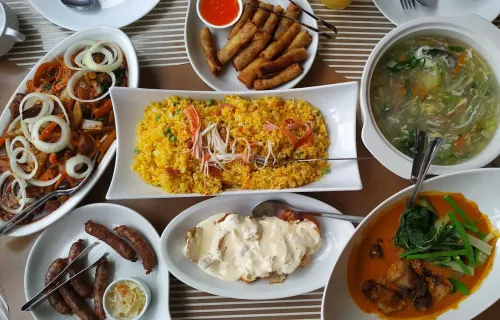
Filipino Food: 12 Essential Dishes (With Tagalog Names)
Filipino food, from adobo to halo-halo: learn the Tagalog names, pronunciations, and ingredients behind 12 dishes you'll want to try on your first trip.
May vs Mayroon vs Meron: Have & There Is
May vs mayroon in Tagalog finally made simple: one rule decides which to use, plus how meron and wala fit the same have and there-is family.