
From root: kamot
Conjugations
Past (Completed)
kumamot
ku-ma-MOT
scratched
Present (Incomplete)
kumakamot
ku-ma-ka-MOT
scratching
Future (Contemplated)
kakamot
ka-ka-MOT
will scratch
Usage Note
Kumamot is used to describe the physical act of scratching an itch, but it is also commonly used in the idiomatic expression 'kamot-ulo' to signify confusion or embarrassment. It typically refers to an actor-focused action where someone is relieving an itch.
Examples
" Huwag kang kumamot diyan. "
Natural Translation
Don't scratch there.
Literal Translation
Don't you scratch there.
" Mahirap kumamot kung may sugat ka. "
Natural Translation
It is hard to scratch if you have a wound.
Literal Translation
Hard scratch if has wound you.
" Tuwing kinakabahan siya, lagi siyang kumakamot sa ulo na para bang naguguluhan sa kung ano ang gagawin. "
Natural Translation
Whenever he gets nervous, he always scratches his head as if confused about what to do.
Literal Translation
Every-time gets-nervous he, always he scratching at head as if confused at whatever the will-do.
Take Tagalog with you
The full course, a 12,500-word dictionary, and flashcards that make every word stick — free to start on iOS and Android.




Tagalog builds thousands of words from a few hundred roots.
How Tagalog words workWord family
kamot has 6 related forms built from the same root.
Related Words
Explore Tagalog by topic
Free guides on grammar, vocabulary, and culture to take you past single-word lookups.

Tagalog vs Filipino: What's the Difference & Which to Learn
Tagalog and Filipino aren't the same language — but they overlap almost completely. Here's the real difference and which one you should actually learn.
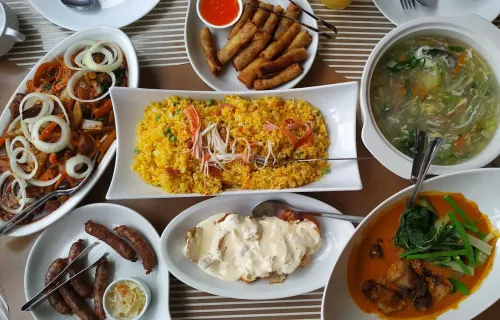
Filipino Food: 12 Essential Dishes (With Tagalog Names)
Filipino food, from adobo to halo-halo: learn the Tagalog names, pronunciations, and ingredients behind 12 dishes you'll want to try on your first trip.

Philippine Christmas Traditions: World's Longest Holiday
Philippine Christmas traditions run four months — from Ber-month carols to Simbang Gabi dawn masses, Noche Buena feasts, and parol lanterns lighting every street.
Po and Opo in Tagalog: Where to Put Them Right
Po and opo confuse learners — but placement follows one rule. Where po goes in a sentence, why it's opo not 'oo po', and the pronoun shift to learn.