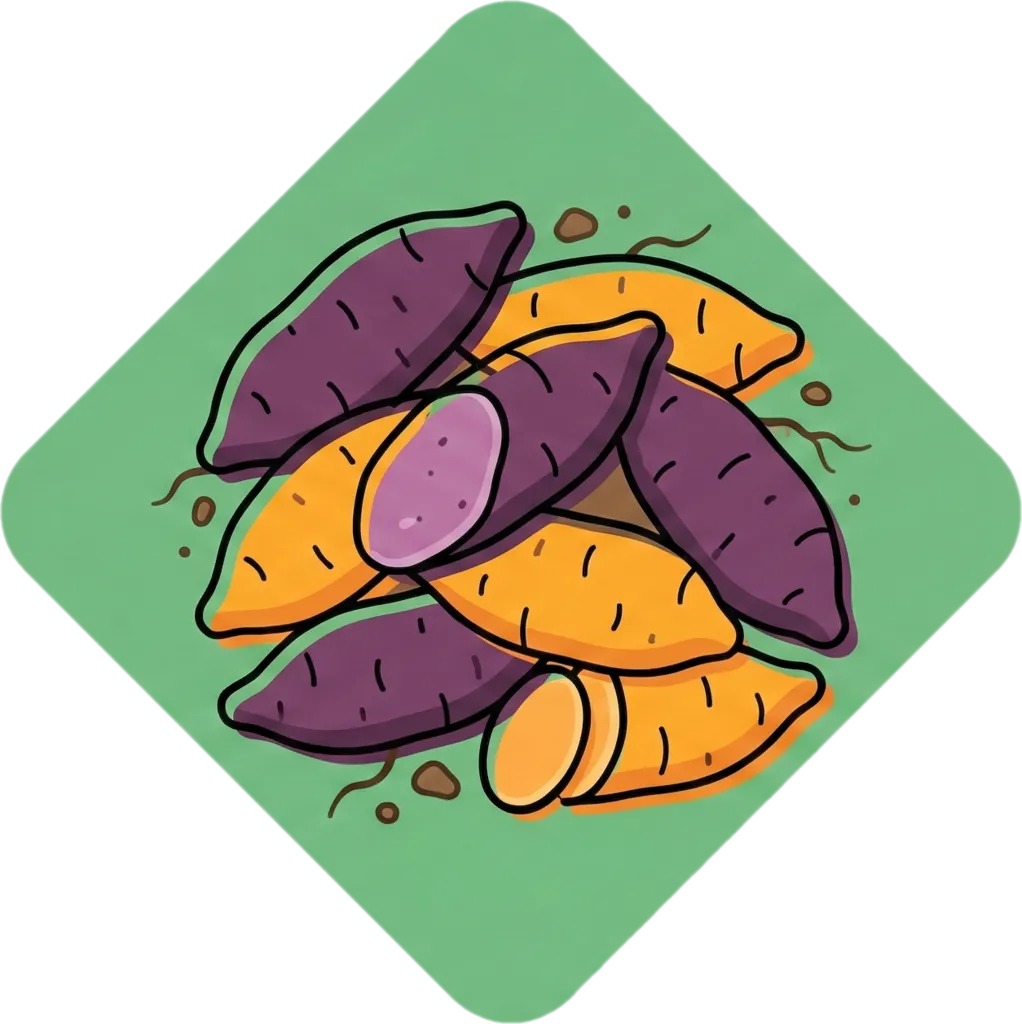
kamote
kamóte with stress marks
sweet potato
Usage Note
Kamote is a staple food in the Philippines, often enjoyed boiled or as a caramelized snack called 'kamote cue.' It is also used colloquially to describe someone who is performing poorly or being reckless, most notably in the term 'kamote driver.'
Examples
" Masarap ang nilagang kamote. "
Natural Translation
Boiled sweet potato is delicious.
Literal Translation
Delicious the boiled sweet-potato.
" Kumain tayo ng nilagang kamote. "
Natural Translation
Let's eat boiled sweet potato.
Literal Translation
Eat we of boiled sweet-potato.
" Noong wala kaming bigas, kamote muna ang aming kinakain hanggang sa makaipon kami para sa pagkain. "
Natural Translation
When we had no rice, we ate sweet potato for the time being until we could save up for food.
Literal Translation
When none our rice, sweet-potato first the our eating until be-able-to-save we for to food.
Take Tagalog with you
The full course, a 12,500-word dictionary, and flashcards that make every word stick — free to start on iOS and Android.




Tagalog builds thousands of words from a few hundred roots.
How Tagalog words workDerived Words
Actor Focus Verbs
Object Focus Verbs
Related Words
Explore Tagalog by topic
Free guides on grammar, vocabulary, and culture to take you past single-word lookups.

Tagalog Greetings: How to Say Hello, Goodbye & Po/Opo
Master Tagalog greetings with pronunciation: kumusta, magandang umaga, po and opo polite forms, time-of-day phrases, and the mano po tradition.
Spaced Repetition for Tagalog: How Flashcards Make Words Stick
Cramming Tagalog vocabulary fails. See how spaced repetition — the science behind smart flashcards — makes words stick for the long term.

Mano Po and Filipino Etiquette: A Visitor's Guide
Mano po presses an elder's hand to your forehead as a blessing. Learn who to mano, how to lip-point, and the etiquette that wins over a Filipino family.

Ng vs Nang in Tagalog: The Spelling Rule
Ng vs nang sound identical but spell differently. Use ng to mark nouns (of, the object), and nang for how, when, repetition, and counting time.