Usage Note
Mas comes from Spanish más and goes before an adjective or adverb to make a comparison: mas mura is 'cheaper', mas mabilis is 'faster'. The thing compared against is introduced by kaysa (kaysa sa / kaysa kay). It is the everyday comparative; higit and lalo are more formal or mean 'even more'.
Examples
" Mas mura ito. "
Natural Translation
This is cheaper.
Literal Translation
More cheap this.
" Mas gusto ko ang kape kaysa sa tsaa. "
Natural Translation
I like coffee more than tea.
Literal Translation
More like I the coffee than to tea.
" Mas mabilis tayong makakarating kung sasakay tayo ng tren sa halip na magmaneho sa ganitong trapik. "
Natural Translation
We'll get there faster if we take the train instead of driving in this kind of traffic.
Literal Translation
More fast we-[linker] will-be-able-to-arrive if will-ride we of train in place that to-drive in like-this traffic.
Take Tagalog with you
The full course, a 12,500-word dictionary, and flashcards that make every word stick — free to start on iOS and Android.




Tagalog builds thousands of words from a few hundred roots.
How Tagalog words workRelated Words
Explore Tagalog by topic
Free guides on grammar, vocabulary, and culture to take you past single-word lookups.
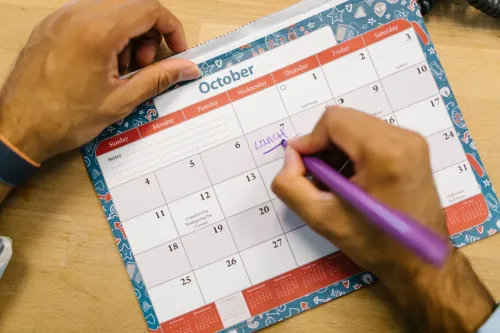
Days of the Week and Months in Tagalog
The days of the week and months in Tagalog are Spanish loanwords. Learn all 7 days and 12 months with pronunciation, plus how to say dates and 'every Monday.'

Tagalog Word Order: Sentence Structure Made Simple
Why Tagalog puts the verb first, and how ang, ng, and sa markers work. A clear guide to VSO word order, forming questions, and negation.

Tagalog Pronouns Explained: Complete Chart with Examples
Every Tagalog pronoun explained with clear charts: ang/ng/sa forms, tayo vs kami, ikaw vs ka, politeness markers, and the mistakes beginners make.

Tagalog Time Expressions: Past, Present & Future Guide
Tagalog has no tenses — it uses aspect. Learn time words, days of the week, clock time, and the aspect system, with vocabulary tables and cultural notes.