Usage Note
Po is the politeness particle added to a sentence when speaking to elders, strangers, or anyone owed respect. It has no direct English equivalent — it works like a spoken bow — and pairs with opo (respectful yes) and the plural pronoun kayo. Leaving it out with an older person can sound abrupt.
Examples
" Salamat po. "
Natural Translation
Thank you (respectfully).
Literal Translation
Thanks [polite].
" Saan po ang pinakamalapit na botika? "
Natural Translation
Where is the nearest pharmacy, please?
Literal Translation
Where [polite] the nearest link pharmacy?
" Pasensya na po kayo kung natagalan ako, mabigat po kasi ang trapiko kanina. "
Natural Translation
Please forgive me for taking so long; the traffic was heavy earlier.
Literal Translation
Patience already [polite] you if took-long I, heavy [polite] because the traffic earlier.
Take Tagalog with you
The full course, a 12,500-word dictionary, and flashcards that make every word stick — free to start on iOS and Android.



Tagalog builds thousands of words from a few hundred roots.
How Tagalog words workRelated Words
Explore Tagalog by topic
Free guides on grammar, vocabulary, and culture to take you past single-word lookups.

Tagalog Greetings: How to Say Hello, Goodbye & Po/Opo
Master Tagalog greetings with pronunciation: kumusta, magandang umaga, po and opo polite forms, time-of-day phrases, and the mano po tradition.

Filipino Family Words and Honorifics: Ate, Kuya & Tita
Filipino family words like ate, kuya, tita, tito, lolo, and lola go far beyond family — learn how Filipinos use them with strangers, plus mano po etiquette.
Magkano: How to Ask "How Much" in Tagalog
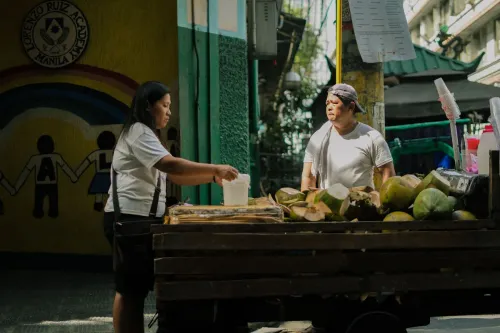
Magkano means how much in Tagalog. Learn to ask a price, tell it apart from ilan and gaano, sound polite with po, and haggle at the palengke.

How to Say "I Love You" in Tagalog: Phrases & Meaning
Learn how to say I love you in Tagalog. Mahal kita, Iniibig kita, and Filipino terms of endearment for partners, family, and friends — with cultural notes.