tingin
tingín with stress marks
look; view, or examine; affection
Usage Note
Tingin serves as both a noun (a look, a view) and a verb root, and it drives several high-frequency forms: tingnan is the object-focus command to look at something, while sa tingin ko — literally 'in my look' — is the standard way to say 'in my opinion' in casual conversation.
Examples
" Tingin ka sa langit. "
Natural Translation
Look at the sky.
Literal Translation
Look you at-the sky.
" Tingin ka dito. "
Natural Translation
Look here.
Literal Translation
Look you here.
" Sa tingin ko, mas mabuting maghintay tayo ng ilang araw bago natin pagdesisyunan ang malaking bagay na ito. "
Natural Translation
In my opinion, it's better that we wait a few days before we decide on this big matter.
Literal Translation
In look my, more better-link wait we of some day before we decide-on the big-link thing link this.
Take Tagalog with you
The full course, a 12,500-word dictionary, and flashcards that make every word stick — free to start on iOS and Android.




Tagalog builds thousands of words from a few hundred roots.
How Tagalog words workDerived Words
Actor Focus Verbs
Object Focus Verbs
Related Words
Explore Tagalog by topic
Free guides on grammar, vocabulary, and culture to take you past single-word lookups.

Seasons in the Philippines: A Tagalog Guide
The Philippines has two seasons, not four. Learn tag-araw, tag-ulan, and taglamig, the generative tag- prefix, and the weather vocabulary to match.
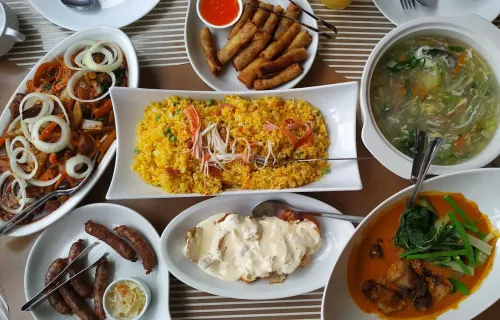
Filipino Food: 12 Essential Dishes (With Tagalog Names)
Filipino food, from adobo to halo-halo: learn the Tagalog names, pronunciations, and ingredients behind 12 dishes you'll want to try on your first trip.

Tagalog Verb Conjugation: Aspects Made Simple
Tagalog verb conjugation uses aspects, not tenses. Learn the three aspects with -um- and mag- verbs, one reduplication rule, and clear example tables.

Ang, Ng, Sa: The 3 Tagalog Case Markers Explained
Ang, ng, sa are the three Tagalog case markers every noun takes. Learn what each does, the personal forms si/ni/kay, plurals with mga, and clear examples.