wansoy
wansóy with stress marks
cilantro; coriander leaves
Usage Note
Wansoy is the Filipino term for fresh coriander leaves (cilantro), borrowed from Hokkien Chinese. It is a common herb used in Filipino-Chinese soups, especially arroz caldo and various noodle dishes. Its distinctive aroma makes it a polarizing ingredient — some love it, others avoid it — but it is a staple in many Filipino kitchens.
Examples
" Ayaw ko ng wansoy. "
Natural Translation
I don't like cilantro.
Literal Translation
Dislike I of cilantro.
" Lagyan mo ng wansoy ang lugaw para mas mabango. "
Natural Translation
Add cilantro to the porridge to make it more fragrant.
Literal Translation
Add-to it of cilantro the porridge for more fragrant.
" Bagama't maraming hindi mahilig sa amoy ng wansoy, idinadagdag pa rin ito sa arroz caldo upang lalong sumarap ang lasa. "
Natural Translation
Although many people don't like the smell of cilantro, it is still added to arroz caldo so that the flavor becomes even better.
Literal Translation
Although many not fond at smell of cilantro, added still it to arroz caldo so even become-delicious the flavor.
Take Tagalog with you
The full course, a 12,500-word dictionary, and flashcards that make every word stick — free to start on iOS and Android.




Tagalog builds thousands of words from a few hundred roots.
How Tagalog words workRelated Words
Explore Tagalog by topic
Free guides on grammar, vocabulary, and culture to take you past single-word lookups.

Is Tagalog Hard to Learn? An Honest Answer
Tagalog takes around 1,100 hours to reach professional proficiency. Here is what is easy, what is hard, and what to expect at 3, 6, and 12 months.
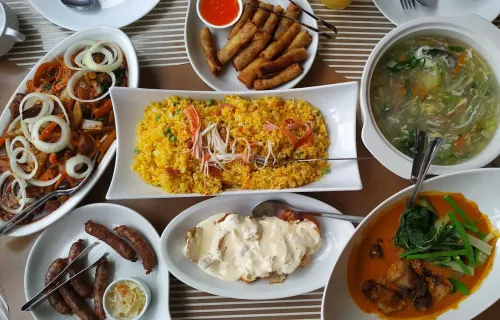
Filipino Food: 12 Essential Dishes (With Tagalog Names)
Filipino food, from adobo to halo-halo: learn the Tagalog names, pronunciations, and ingredients behind 12 dishes you'll want to try on your first trip.

Filipino Family Words and Honorifics: Ate, Kuya & Tita
Filipino family words like ate, kuya, tita, tito, lolo, and lola go far beyond family — learn how Filipinos use them with strangers, plus mano po etiquette.
Magkano: How to Ask "How Much" in Tagalog
Magkano means how much in Tagalog. Learn to ask a price, tell it apart from ilan and gaano, sound polite with po, and haggle at the palengke.