bangungot
bangungót with stress marks
nightmare
Usage Note
Bangungot originally referred to the phenomenon of sudden nocturnal death in otherwise healthy young men — a culturally recognized condition known internationally as sudden unexplained nocturnal death syndrome (SUNDS). Folk belief attributes it to a demon sitting on the sleeper's chest. In modern usage it more commonly means simply a bad dream or nightmare, but the older, darker meaning persists in traditional lore.
Examples
" Masama ang bangungot ko kagabi. "
Natural Translation
I had a bad nightmare last night.
Literal Translation
Bad the nightmare my last-night.
" Nagising siyang nag-iiyak dahil sa masamang bangungot. "
Natural Translation
He/She woke up crying because of a terrible nightmare.
Literal Translation
Woke he/she crying because of-the terrible nightmare.
" Tuwing kumakain siya ng malaman bago matulog, lagi siyang ginigising ng nakakatakot na bangungot. "
Natural Translation
Whenever he eats something heavy before sleeping, he is always awakened by a frightening nightmare.
Literal Translation
Every-time eats he of filling before sleep, always he awakened by scary nightmare.
Take Tagalog with you
The full course, a 12,500-word dictionary, and flashcards that make every word stick — free to start on iOS and Android.




Tagalog builds thousands of words from a few hundred roots.
How Tagalog words workRelated Words
Explore Tagalog by topic
Free guides on grammar, vocabulary, and culture to take you past single-word lookups.

Na vs -ng in Tagalog: The Linker Rule Made Simple
When do you use na vs -ng in Tagalog? One simple rule, with clear examples, memory tips, and common mistakes explained for English-speaking beginners.

Tagalog Greetings: How to Say Hello, Goodbye & Po/Opo
Master Tagalog greetings with pronunciation: kumusta, magandang umaga, po and opo polite forms, time-of-day phrases, and the mano po tradition.

Magkano: How to Ask "How Much" in Tagalog
Magkano means how much in Tagalog. Learn to ask a price, tell it apart from ilan and gaano, sound polite with po, and haggle at the palengke.
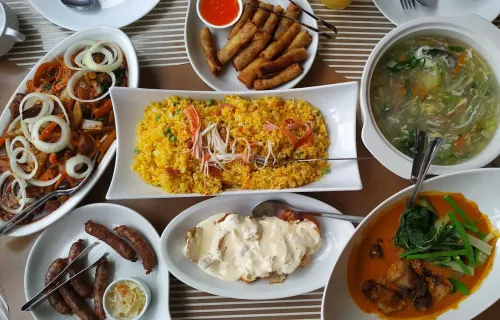
Filipino Food: 12 Essential Dishes (With Tagalog Names)
Filipino food, from adobo to halo-halo: learn the Tagalog names, pronunciations, and ingredients behind 12 dishes you'll want to try on your first trip.