guniguni
gunigúni with stress marks
hallucination, imagination
Usage Note
Guniguni refers to something imagined, hallucinated, or not real — a figment of the mind. It is used to dismiss superstitious fears ('it's just your imagination') or to describe vivid hallucinations. The reduplicated form reinforces the sense of something intangible and illusory.
Examples
" Guniguni mo lang iyan. "
Natural Translation
That's just your imagination.
Literal Translation
Imagination your just that.
" Guniguni lang iyon; wala talagang multo doon. "
Natural Translation
That's just your imagination; there's really no ghost there.
Literal Translation
Imagination just that; none really ghost there.
" Tuwing mag-isa siya sa lumang bahay, lagi niyang naririnig ang mga yabag na, sa katunayan, guniguni lamang ng kanyang takot na isipan. "
Natural Translation
Whenever he's alone in the old house, he always hears footsteps that are, in truth, just figments of his frightened mind.
Literal Translation
Every-time alone he in old house, always he hearing the footsteps that, in truth, imagination only of his frightened mind.
Take Tagalog with you
The full course, a 12,500-word dictionary, and flashcards that make every word stick — free to start on iOS and Android.




Tagalog builds thousands of words from a few hundred roots.
How Tagalog words workRelated Words
Explore Tagalog by topic
Free guides on grammar, vocabulary, and culture to take you past single-word lookups.

Tagalog Slang Guide: 20 Words You'll Hear on TikTok
Tagalog slang explained: lodi, petmalu, werpa, astig, chika and more. Decode Filipino TikTok comments, group chats, and pop culture with this practical guide.
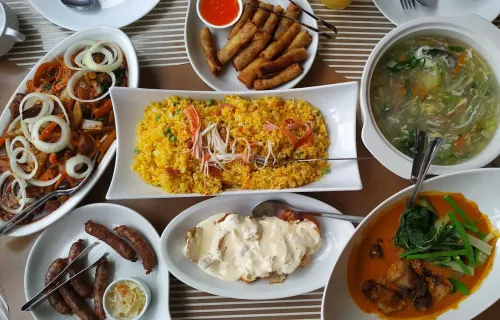
Filipino Food: 12 Essential Dishes (With Tagalog Names)
Filipino food, from adobo to halo-halo: learn the Tagalog names, pronunciations, and ingredients behind 12 dishes you'll want to try on your first trip.

Tagalog Greetings: How to Say Hello, Goodbye & Po/Opo
Master Tagalog greetings with pronunciation: kumusta, magandang umaga, po and opo polite forms, time-of-day phrases, and the mano po tradition.

Philippine Christmas Traditions: World's Longest Holiday
Philippine Christmas traditions run four months — from Ber-month carols to Simbang Gabi dawn masses, Noche Buena feasts, and parol lanterns lighting every street.