luwa
luwá with stress marks
religious poem or chant
Also means
Luwa can also mean to bulge or protrude.
Usage Note
Luwa is a poetic oration or chant traditionally performed by a child to honor a patron saint or the Virgin Mary during religious festivals. It is often delivered from a decorated platform during a procession as a rhythmic, memorized display of devotion.
Examples
" Maganda ang luwa ng bata. "
Natural Translation
The child's chant is beautiful.
Literal Translation
Beautiful the chant of child.
" Binigkas niya ang isang lumang luwa. "
Natural Translation
He recited an old religious chant.
Literal Translation
Recited he/she the a old chant.
" Tuwing kapistahan, umaakyat ang isang batang babae sa entablado upang bigkasin ang luwa bilang pagpupugay sa mahal na patron ng bayan. "
Natural Translation
Every fiesta, a young girl climbs onto the stage to recite the chant as a tribute to the town's beloved patron saint.
Literal Translation
At every fiesta, climbs the one young girl onto stage to recite the chant as tribute to dear patron of town.
Take Tagalog with you
The full course, a 12,500-word dictionary, and flashcards that make every word stick — free to start on iOS and Android.




Tagalog builds thousands of words from a few hundred roots.
How Tagalog words workDerived Words
Actor Focus Verbs
Object Focus Verbs
Related Words
Explore Tagalog by topic
Free guides on grammar, vocabulary, and culture to take you past single-word lookups.

Na vs -ng in Tagalog: The Linker Rule Made Simple
When do you use na vs -ng in Tagalog? One simple rule, with clear examples, memory tips, and common mistakes explained for English-speaking beginners.
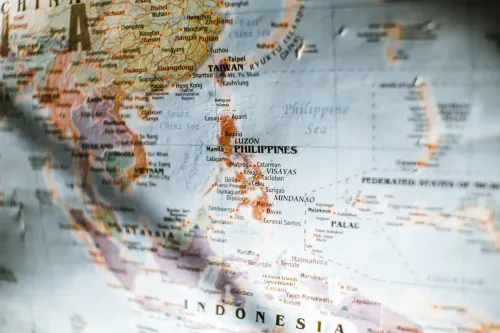
Philippines Geography for Learners: Islands & Language
Philippines geography for Tagalog learners: 7,641 islands, three island groups, and the Southern Luzon heartland where the Tagalog language was born.

Seasons in the Philippines: A Tagalog Guide
The Philippines has two seasons, not four. Learn tag-araw, tag-ulan, and taglamig, the generative tag- prefix, and the weather vocabulary to match.
Tagalog vs Filipino: What's the Difference & Which to Learn
Tagalog and Filipino aren't the same language — but they overlap almost completely. Here's the real difference and which one you should actually learn.