tsampoy
tsampóy with stress marks
Chinese strawberry candy
Usage Note
Tsampoy is from Hokkien Chinese and refers to dried preserved plum or Chinese strawberry confection sold in small packets — a nostalgic childhood snack widely available in Philippine sari-sari stores and Chinese grocery shops. Its sweet-sour-salty flavor makes it instantly recognizable.
Examples
" Gusto ko ng tsampoy. "
Natural Translation
I want some Chinese strawberry candy.
Literal Translation
Want I of Chinese-strawberry-candy.
" Kumain ang bata ng tsampoy. "
Natural Translation
The child ate Chinese strawberry candy.
Literal Translation
Ate the child of Chinese strawberry candy.
" Tuwing bibisita kami sa lola namin, palagi siyang may handang tsampoy na binibili niya sa tindahan ng mga Tsino. "
Natural Translation
Whenever we visit our grandmother, she always has tsampoy ready that she buys from the Chinese store.
Literal Translation
Whenever visit we to grandmother our, always she has ready Chinese-strawberry-candy that buys she in store of Chinese.
Take Tagalog with you
The full course, a 12,500-word dictionary, and flashcards that make every word stick — free to start on iOS and Android.




Tagalog builds thousands of words from a few hundred roots.
How Tagalog words workRelated Words
Explore Tagalog by topic
Free guides on grammar, vocabulary, and culture to take you past single-word lookups.

Tagalog Word Order: Sentence Structure Made Simple
Why Tagalog puts the verb first, and how ang, ng, and sa markers work. A clear guide to VSO word order, forming questions, and negation.
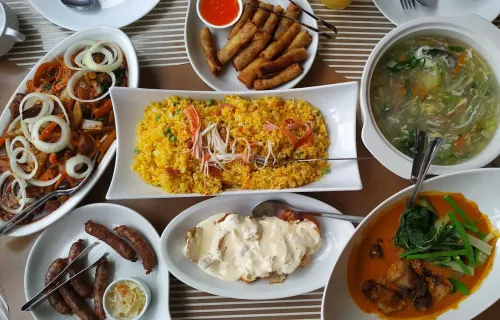
Filipino Food: 12 Essential Dishes (With Tagalog Names)
Filipino food, from adobo to halo-halo: learn the Tagalog names, pronunciations, and ingredients behind 12 dishes you'll want to try on your first trip.

Is Tagalog Hard to Learn? An Honest Answer
Tagalog takes around 1,100 hours to reach professional proficiency. Here is what is easy, what is hard, and what to expect at 3, 6, and 12 months.

Filipino Family Words and Honorifics: Ate, Kuya & Tita
Filipino family words like ate, kuya, tita, tito, lolo, and lola go far beyond family — learn how Filipinos use them with strangers, plus mano po etiquette.