Usage Note
Langka (jackfruit) is one of the largest tree fruits in the world and a staple in Filipino cuisine. Ripe langka is eaten fresh or used in desserts like 'halo-halo'; unripe langka ('batwan') is used as a meat substitute in savoury dishes like 'ginataang langka'. The fruit's distinctive sweet aroma is immediately recognisable in Filipino markets.
Examples
" Mabango ang langka. "
Natural Translation
The jackfruit smells good.
Literal Translation
Fragrant the jackfruit.
" Matamis ang langka. "
Natural Translation
The jackfruit is sweet.
Literal Translation
Sweet the jackfruit.
" Kapag hinog na ang langka sa likod-bahay, inilalagay namin ito sa halo-halo o kinakain agad habang sariwa pa. "
Natural Translation
When the jackfruit in the backyard is ripe, we put it in halo-halo or eat it right away while it is still fresh.
Literal Translation
When ripe already the jackfruit at back-house, put we it in halo-halo or eat immediately while fresh still.
Take Tagalog with you
The full course, a 12,500-word dictionary, and flashcards that make every word stick — free to start on iOS and Android.




Tagalog builds thousands of words from a few hundred roots.
How Tagalog words workRelated Words
Explore Tagalog by topic
Free guides on grammar, vocabulary, and culture to take you past single-word lookups.

Mano Po and Filipino Etiquette: A Visitor's Guide
Mano po presses an elder's hand to your forehead as a blessing. Learn who to mano, how to lip-point, and the etiquette that wins over a Filipino family.

Magkano: How to Ask "How Much" in Tagalog
Magkano means how much in Tagalog. Learn to ask a price, tell it apart from ilan and gaano, sound polite with po, and haggle at the palengke.
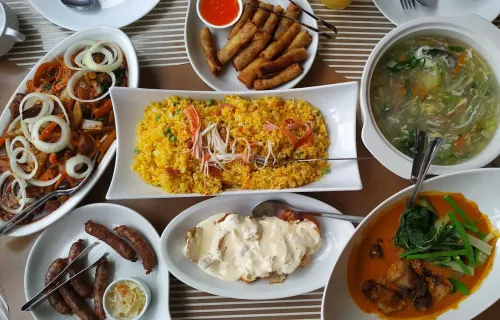
Filipino Food: 12 Essential Dishes (With Tagalog Names)
Filipino food, from adobo to halo-halo: learn the Tagalog names, pronunciations, and ingredients behind 12 dishes you'll want to try on your first trip.

Ng vs Nang in Tagalog: The Spelling Rule
Ng vs nang sound identical but spell differently. Use ng to mark nouns (of, the object), and nang for how, when, repetition, and counting time.